One Day Your Site Will Go Down. Do You Know Who's Going to Fix It?
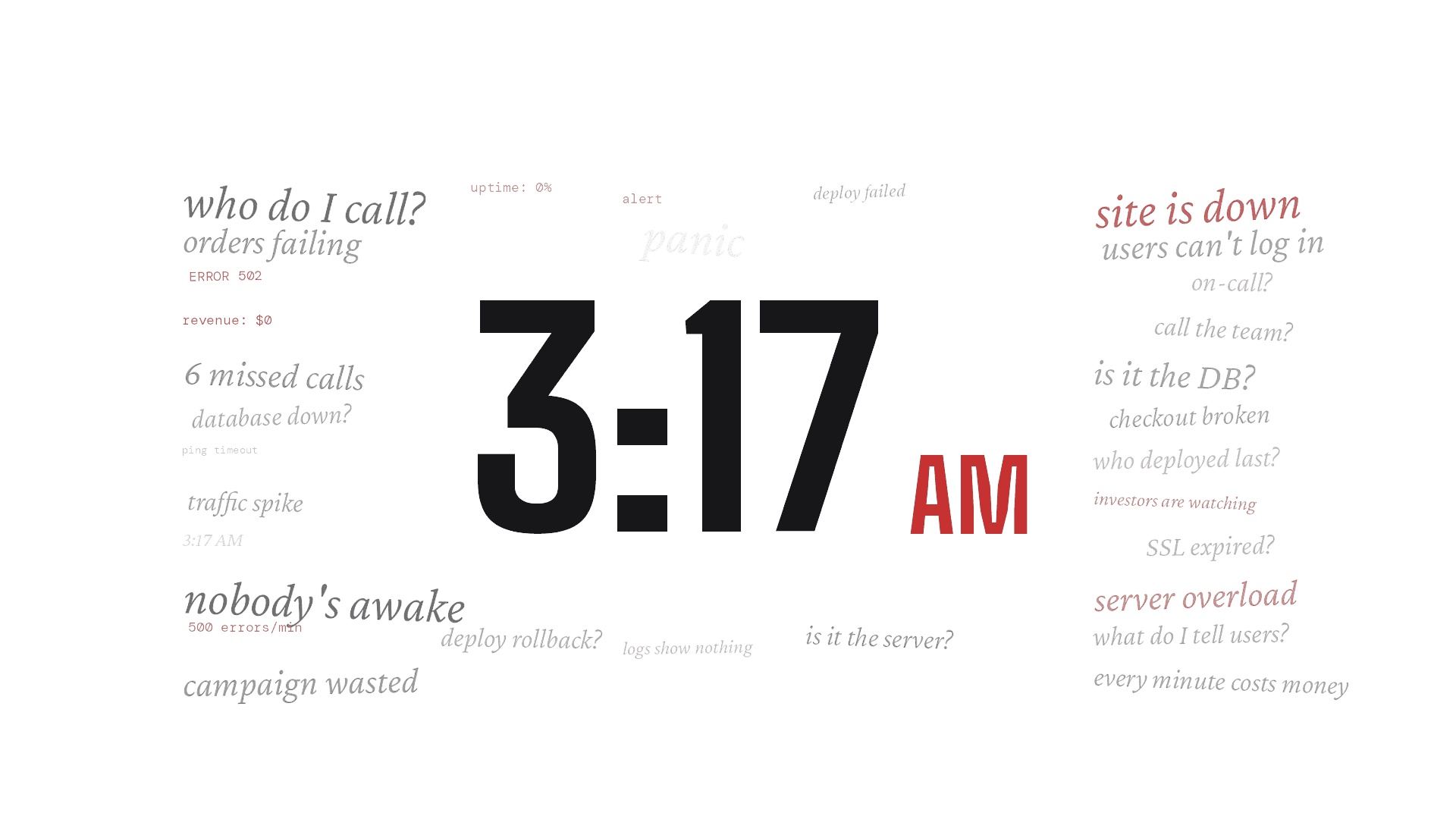
It's 3:17 AM on a Tuesday.
Your e-commerce platform just went down under a traffic spike you didn't see coming. Orders are failing. Customers are bouncing. Every minute offline is money you're not making, and you're asleep.
Who fixes it?
If you're on a Start Matter support plan, you don't have to worry about that question. We're already watching. We get the alert, we get to work, and by the time your team wakes up and checks their phones, the issue is resolved and there's a summary waiting in their inbox.
That's not a fantasy. That's what happened for one of our clients last year.
The Real Cost of "We'll Handle It When It Happens"
Most startup founders think about website support the same way people think about health insurance in their 20s"I'm healthy, nothing's happened yet, I'll deal with it later."
Then something breaks.
And just like the uninsured person who ends up in the ER paying $12,000 out of pocket for something a monthly premium would have handled, founders without a support plan pay emergency rates for fixes a proactive plan would have prevented. The bill arrives. It's always bigger than the coverage would have cost. And there's no going back.
And suddenly they're scrambling to find a developer who's available right now, who's willing to touch code they didn't write, at 11 PM on a Friday, for emergency rates.
The average cost of a single unplanned production incident for a SaaS startup:
- Emergency developer time: $150 to $300/hour
- Lost revenue during downtime: varies, often $1,000 to $10,000+
- Customer churn from lost trust: hard to measure, impossible to undo
- Founder time spent managing the crisis instead of the business: priceless (and exhausting)
A monthly support plan costs a fraction of one incident. And it prevents most incidents from happening in the first place.
“|”
Real Story: The 3 AM Crash
A SaaS client ran a promotional campaign that drove 4x their normal traffic overnight. Their server couldn't handle it. The app went down at 3:17 AM.Because they were on a Start Matter support plan, our on-call engineer received the alert automatically. Within 11 minutes we had scaled their infrastructure, cleared the queue backlog, and brought the app back online.
Total downtime: 23 minutes, invisible to most users.
Without a support plan? That outage would have lasted until 9 AM when someone finally noticed. Six hours of downtime during a promotional campaign. Every email they sent driving traffic to a broken page.
Your project is live: but who's watching it?
We take on projects we didn't build. It doesn't matter who wrote the code, what stack it runs on, or how complete the docs are.
Tell us about your product and what worries you most. We'll be straight with you about what you need.
What Startup Founders Actually Lose When Their Site Goes Down
Let's be specific about the pain, because it's more than just "the site is broken."
You lose revenue directly. Every transaction that can't complete is gone. Unlike a store that can stay open late to make up for a slow afternoon, a website outage during peak hours is unrecoverable.
You lose the traffic you paid for. If you're running paid ads, sending newsletters, or riding a Product Hunt launch, every visitor who hits a broken page is money you already spent to acquire them. Now wasted.
You lose trust. First-time visitors who encounter a broken site don't come back. Existing users start wondering if you're a real company. Investors who happen to check your URL at the wrong moment form an impression that's hard to correct.
You lose focus. A founder in crisis mode is not thinking about strategy, sales, or product. They're refreshing error logs and texting developers at midnight. That cognitive cost doesn't show up on a balance sheet, but it's real.
You lose time you can't get back. The hours you spend managing an incident are hours you're not spending on anything that grows your business.
The Problem With "Launch and Leave"
Most digital products get launched with care. Requirements, sprints, QA, deployment, all done properly. And then the project closes, the team disperses, and the product is left to run on its own.
For a while, it works.
But software doesn't exist in a vacuum. Dependencies update. Platforms change their APIs. Traffic patterns shift. A library that was secure in January has a known vulnerability by March. A hosting provider changes their pricing model and suddenly your infrastructure bill doubles.
None of this is dramatic. It's just the normal entropy of technology. And without someone actively watching, it compounds quietly until it becomes a crisis.
The question isn't whether something will go wrong. It's whether you'll have someone in your corner when it does.
Think of it like car insurance. You don't buy it because you plan to crash. You buy it because the road is unpredictable, and the cost of being wrong without coverage is catastrophic. A website support plan works the same way. You hope you never need the 3 AM call. But when you do, you need to know someone's picking up.
“|”
Real Story: Abandoned on AWS
A startup came to us after their previous agency had built their platform on AWS, and then gone dark. The infrastructure was overconfigured, expensive, and the founder had no idea how to manage it.
They were paying $2,200/month for hosting they didn't fully understand, couldn't get support for, and were terrified to touch.
We audited the setup in the first week of their support plan. Migrated the entire stack to DigitalOcean with equivalent, actually better, performance. Set up proper monitoring, automated backups, and documented everything clearly so the team could understand what they were running.
Monthly infrastructure cost dropped from $2,200 to $380.
The savings from that single optimization paid for over a year of their support subscription.
Not sure what you are overpaying for on your server?
Most projects that come to us after another agency are paying 2 to 5x more than they should. We run an infrastructure audit in the first week. In most cases, the savings cover the cost of the subscription.
Send us your stack details. We'll handle the rest.
What a Website Support Plan Actually Includes
When you sign a monthly support subscription with Start Matter, you're not buying access to a help desk. You're reserving dedicated engineering capacity allocated specifically to your product every month.
This matters. When something breaks at 2 AM on a Sunday, you don't want to be in a queue. You want a team that already knows your codebase, your infrastructure, your edge cases, and has dedicated time to respond immediately.
Here's what that capacity covers:
24/7 Monitoring and Incident Response We instrument your infrastructure with alerts. When something goes wrong, server overload, error rate spike, SSL expiry, failed deploy, we receive the notification and act on it. You find out after it's fixed, not when your users start complaining.
Proactive Maintenance Security patches. Dependency updates. Compatibility fixes for new browser versions, OS updates, third-party API changes. We handle these before they become incidents. Most of the crises we prevent are ones our clients never knew were coming.
5 to 10 Hours of Product Improvements Every Month Every subscription includes dedicated hours for new features and enhancements, not just firefighting. A new integration here. A UX improvement there. A performance optimization that's been on the backlog for months. Small, consistent improvements compound into a meaningfully better product over time.
Infrastructure Cost Optimization We actively review your server spend, cloud configurations, and third-party subscriptions on a regular basis. If there's a more efficient architecture, a better-priced provider, or a service you're paying for but not using, we find it and we fix it.
A Team That Already Knows Your Product No onboarding delay. No time spent re-reading documentation. When something needs attention, we're already up to speed. That's only possible through a long-term relationship, and it's one of the most underrated advantages of a support plan.
We Optimize What You're Already Paying For
Over time, infrastructure accumulates waste. A staging server that's still running in production. An old SaaS subscription that three people signed up for and nobody uses. A database plan sized for 2022 traffic that's now 3x larger than necessary.
As part of every support plan, we conduct regular reviews of your server and third-party costs. We're not just keeping the lights on. We're looking for ways to reduce waste, improve performance, and make your infrastructure more resilient.
What we actively optimize:
- Cloud infrastructure (AWS, GCP, DigitalOcean, Hetzner)
- Database performance and right-sizing
- CDN and caching configuration
- Third-party SaaS spend: APIs, monitoring tools, email delivery services
- CI/CD pipelines and build times
- Backup strategies and disaster recovery readiness
In many cases, the savings from the first infrastructure audit cover a significant portion of the annual subscription cost.
“|”
Real Story: The Security Patch Nobody Noticed
A critical vulnerability was published for a popular open-source library used across dozens of Node.js projects. Within 48 hours, active exploits were circulating.
For clients on Start Matter support plans, we had already identified which projects used the affected library and applied the patch before any exploit attempt could reach them.
Most clients found out about it in their weekly update email, not in an incident report.
Result: zero security incidents across all affected client projects.
Clients without ongoing support found out about the vulnerability when they read the news. And then spent the next week scrambling to figure out which of their dependencies were affected and how to fix it.
“|”
Why Flexibility Matters More Than You Think
Every startup is different. A company six weeks post-launch has completely different needs than one that's been running for three years with thousands of daily users.
Start Matter support plans are designed to reflect that reality.
We've had clients on support for over 8 years: relationships that started with intensive post-launch coverage and settled into lighter, steady-state maintenance as the product matured. We've also had clients who needed heavy support for a few months around a major feature release and then scaled back.
Both are valid. Neither is locked in.
When you're growing fast, we scale with you. When things are steady, you're not paying for capacity you don't need. And when a major project comes up, a platform migration, a redesign, a new market launch, the team that already knows your product is in place to handle it immediately.
That continuity isn't something you can buy on demand. It's built month by month, through a relationship that compounds over time.
The Math Every Founder Should Run
Here's a simple calculation worth doing before your next incident:
Scenario: estimated cost without support
- Emergency dev time (4 hours at $200/hr): $800
- Revenue lost during 4-hour outage: $500 to $5,000+
- Paid ad spend wasted on broken landing page: $200 to $2,000
- Overprovisioned infrastructure (annual): $5,000 to $20,000
- Security incident response and remediation: $3,000 to $50,000+
One serious incident often costs more than a full year of support.
And that's before accounting for the intangible costs: founder time, team stress, customer trust, and the opportunity cost of being in crisis mode instead of building.
Nobody questions whether to insure a $500,000 piece of equipment. But founders regularly leave their revenue-generating product, the thing the entire business runs on, completely unprotected. The logic doesn't hold up.
"The question was never 'can we afford a support plan?' It's 'what does it cost us not to have one?'"
Ready to hand your project to a team that will actually keep it running?
We work with any stack, even if you don't know who last deployed or where the server credentials are.
Just reach out. We'll figure it out.
What Founders and CTOs Say After Their First Year
"After the first time something broke and you guys just… fixed it before I even knew there was a problem, I stopped thinking about infrastructure entirely. That's exactly what I wanted."
"We tried managing things ourselves for six months after launch. It was a constant background stress. The support plan removed that completely."
"The infrastructure audit alone paid for the first year of the subscription. I wish we'd done it earlier."
Is a Support Plan Right for Your Startup Right Now?
If your product is live and being used by real people, yes, almost certainly.
The right question is what level of support makes sense for where you are. Early-stage startups typically need lighter coverage with a strong incident response guarantee. Growth-stage companies need more proactive capacity and regular optimization. Established products need continuity and a team that knows the history.
At Start Matter, we start every support conversation by understanding the product, the team, and the goals, and then designing something that actually fits. No bloated packages, no unnecessary overhead.
Just a team that treats your product like their own, and is on call when you need them.
Ready to Stop Worrying About What Happens When You're Not Watching?
Let's talk. Tell us about your product, your current setup, and what keeps you up at night. We'll tell you honestly what we think you need, and what you don't.
Related reading
The infrastructure side of keeping a SaaS up:
- How we stopped clients complaining "site is down again": AWS, Kubernetes, ArgoCD playbook
- Hire vs Engage: the 2026 math: when a 4-hour-a-week senior beats a salaried DevOps hire
- MVP cost in 2026: pricing for ongoing engagements
For city-specific SaaS support and infra work: SaaS development in San Francisco, Seattle, New York. To engage a senior SaaS engineer directly: Hire a SaaS developer in Miami or Atlanta.
Enjoyed this article? Share it with others
Related Posts

From Enrichlead to Moltbook: A Short Tour of the Vibe-Coded Graveyard
Four public, sourced vibe-coding incidents from March 2025 to early 2026: a paywall enforced in the browser, apps with open databases, an AI agent that wiped production, and a leaked database key. Only one is known to have died. Here is what broke in each.

We Inherited an AI-Generated Codebase. Here Is What We Found
The platform worked in the demo and was signing institutions. Underneath, authorization was broken, organizations could see each other's data, uploads failed, there was no deploy process, keys were hardcoded and there were no tests. Here is what we found and six checks for yours.

One Profile, Two Products: What an Identity Layer Has to Survive
SportsID gives an athlete one permanent record that travels from camp to college. CoachID hires coaches off the same idea. Two products, one identity underneath, and that underneath part is where the engineering actually lives.